


For many SMB founders, marketing often feels like a constant cycle of activity.
Post on social media.
Run ads.
Redesign the website.
Send emails.
Repeat.
Yet despite all the effort, growth remains inconsistent.
Leads fluctuate. Sales teams struggle with quality enquiries. Marketing spends increase without clear outcomes.
At this point, many business owners start looking for help and come across a common question:
What does a marketing consultant actually do?
If your answer is “manage ads” or “create content,” you’re only seeing a small part of the picture.
A marketing consultant helps SMBs build a structured growth system—not just execute marketing tasks.
Let’s understand what that really means.
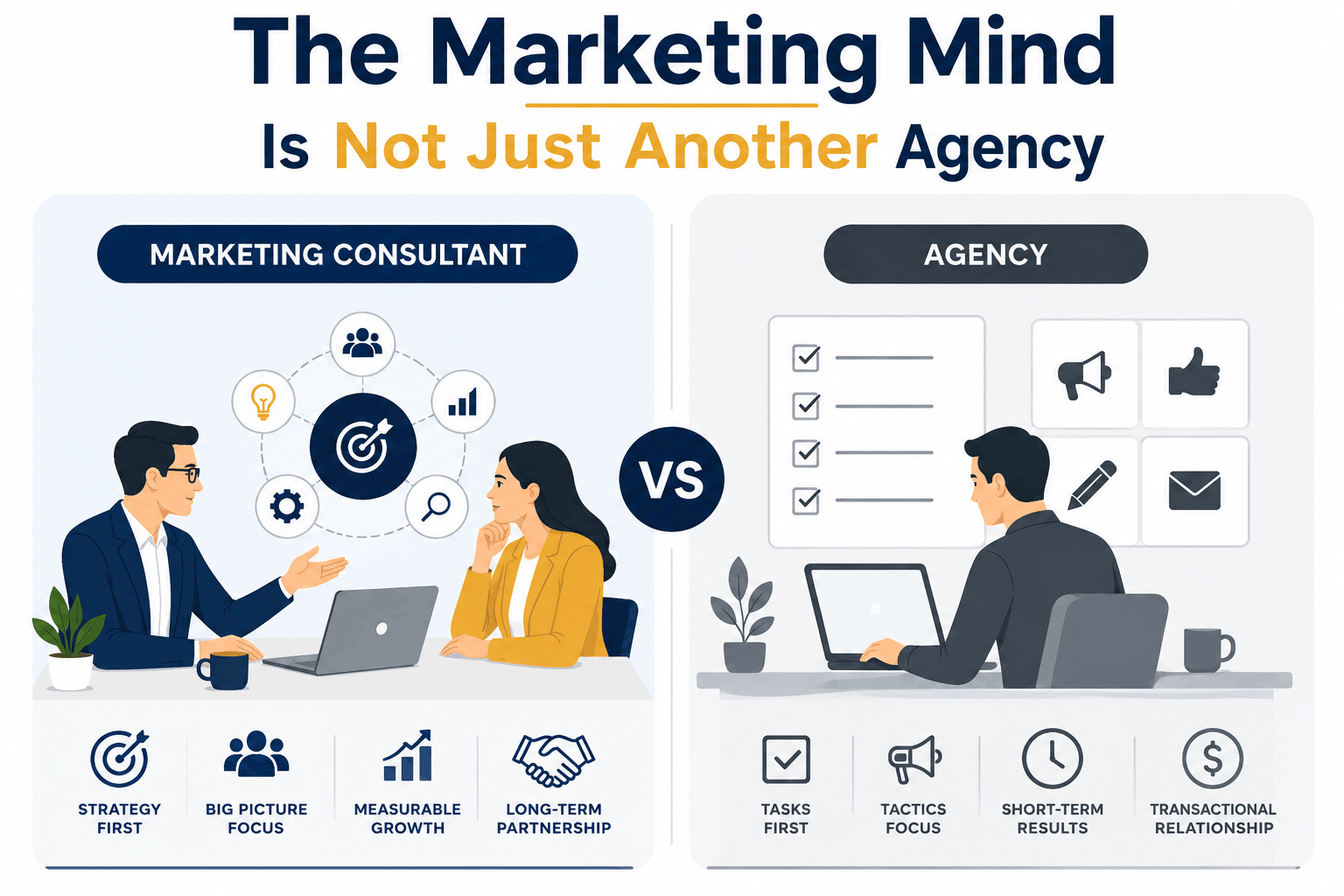
First, A Marketing Consultant Is Not Just Another Agency
Many SMBs approach marketing support expecting quick campaign execution.
But execution without direction often leads to random outcomes.
A marketing consultant works differently.
Instead of starting with:
- Which platform should we advertise on?
- How many posts should we publish?
- What budget should we allocate?
A consultant starts with questions like:
- Who exactly are we trying to attract?
- Why should customers choose us?
- Where is the current funnel breaking?
- What is preventing growth?
- Which activities actually move revenue?
The objective is simple:
Create clarity before creating campaigns.
What a Marketing Consultant Actually Does
1. Builds Strategy Before Execution
Most SMBs jump into marketing tactics too early. A marketing consultant creates a growth roadmap by defining:
- Business goals
- Target audience
- Positioning
- Channels
- Messaging priorities
Strategy reduces guesswork and improves ROI.
2. Sharpens Positioning
Many businesses sound the same. A consultant helps answer:
- Why choose you?
- What makes you different?
- How should you communicate value?
Clear positioning makes selling easier.
3. Creates a Repeatable Lead Engine
Growth shouldn’t depend only on referrals. Consultants build systems using:
- Website
- SEO
- Content
- Paid campaigns
- CRM
The goal: predictable opportunities.
4. Aligns Sales and Marketing
Marketing generates demand. Sales converts demand.
A consultant improves alignment through:
- Lead qualification
- Funnel design
- Customer journey
- Performance tracking
Better alignment leads to better conversions.
5. Introduces Measurement and Processes
Marketing should be measurable, not based on assumptions. Consultants implement:
- KPIs
- Conversion tracking
- CAC & ROI analysis
- Reporting systems
Better decisions come from data.
6. Strengthens Internal Teams
Great consultants don’t create dependency—they build capability through:
- Training
- Process documentation
- Mentoring
- Planning frameworks
The goal is long-term marketing maturity.

What a Marketing Consultant Actually Does
1. Builds Strategy Before Execution
Most SMBs jump into marketing tactics too early. A marketing consultant creates a growth roadmap by defining:
- Business goals
- Target audience
- Positioning
- Channels
- Messaging priorities
Strategy reduces guesswork and improves ROI.
2. Sharpens Positioning
Many businesses sound the same. A consultant helps answer:
- Why choose you?
- What makes you different?
- How should you communicate value?
Clear positioning makes selling easier.
3. Creates a Repeatable Lead Engine
Growth shouldn’t depend only on referrals. Consultants build systems using:
- Website
- SEO
- Content
- Paid campaigns
- CRM
The goal: predictable opportunities.
4. Aligns Sales and Marketing
Marketing generates demand. Sales converts demand.
A consultant improves alignment through:
- Lead qualification
- Funnel design
- Customer journey
- Performance tracking
Better alignment leads to better conversions.
5. Introduces Measurement and Processes
Marketing should be measurable, not based on assumptions. Consultants implement:
- KPIs
- Conversion tracking
- CAC & ROI analysis
- Reporting systems
Better decisions come from data.
6. Strengthens Internal Teams
Great consultants don’t create dependency—they build capability through:
- Training
- Process documentation
- Mentoring
- Planning frameworks
The goal is long-term marketing maturity.
Signs Your SMB May Need a Marketing Consultant
You don’t need consulting because business is failing—you need it when growth becomes harder to manage.
You may need support if:
- Marketing feels disconnected
- Sales are inconsistent
- Leads lack quality
- Website isn’t generating business
- Growth depends only on referrals
- Teams lack direction
- ROI is unclear
- Growth has slowed
These are usually strategy and process problems—not execution issues.
What Outcomes Should SMBs Expect?
A marketing consultant helps create:
✓ Stronger positioning
✓ Better decisions
✓ Higher-quality leads
✓ Sales–marketing alignment
✓ Clearer ROI visibility
✓ Stronger internal capability
✓ Sustainable growth systems
The goal isn’t more marketing. It’s better marketing.
How to Choose the Right Marketing Consultant
Before hiring, ask:
- Do they understand your business?
- Do they offer strategy—not just execution?
- Can they measure outcomes?
- Will they strengthen your team?
- Can they connect marketing to business growth?
Choose someone who helps you think better—not market louder.
Final Thoughts
Marketing today is more than campaigns and content.
SMBs grow faster with clear strategy, strong positioning, defined processes, and better decisions.
That’s what a marketing consultant delivers—
not more activity, but clarity.